Showing posts with label Langtang. Show all posts

Monday, June 21, 2010

Morning Prayers

Modern sleeping sacks are very constricting. It is impossible to roll over without taking the whole sack with you. When I crawled into my sleeping bag, I was fairly toasty and ready for sleep. A few hours later, I realized I was not sleeping well at all. My feet were very cold. It is also true that it can be very difficult to sleep at high altitudes if you are not acclimated and we were high enough that I could have been suffering a little altitude sickness. In any case, I was wide awake by the time Belief and Atit came politely rapping at our chamber door. It was still quite dark outside, even though I think that they let us sleep in, until at least 5 am.

I was eager to get back into the warm bath, so I jumped up and pulled on my swimming suit hastily. It was a most remarkable coincidence that I had a suit with me at all. The day before I packed for Nepal, a friend had sent me a box of books to donate to the children at the village school. She included pencils and stickers, which came in very handy, and surprisingly, she sent me a new swimming suit that she had bought in the wrong size for herself. I would normally never pack a swimming suit for Nepal. Pools are hard to come by and I am suspicious of the water quality. But the suit was there in my hand, and so I threw it into the case. I had no idea that the my adopted family would be taking me on a trip up to the hot springs at Tatopani.

Tania needed a little extra time for her morning ablutions, so the boys and I went ahead of her to the baths. As we approached, I heard the deep, sonorous harmonies of "Om mani padme hum." At the far side of the tub, beneath the spigots, were three monks each with a sacred white head covering. They chanted all the while as we disrobed, the boys stripping to their underwear. I was a little concerned that my feminine flesh would be disturbing to the monks but the boys didn't appear to have any reservations. Tania followed the chants and soon found her way to the tubs well. She peeled down to a bikini and entered the water as discreetly as possible. We stayed very quiet so as not to disturb the morning meditation. I settled in on the right side of the tub and watched enraptured as the sun, rising in concert with the melodic chants, began to lighten the sky behind the mountain peaks. As our surroundings brightened, to my amazement, I watched the monks transform completely. It was soon clear that these were not men at all but women with very deep voices. Nuns, perhaps, I thought. A few moments later I could see that the sacramental vestiments they wore on their heads were actually white plastic bags meant to keep their hair from getting wet.  Sacred and holy all the same, but still a very good reminder that events are not always as they appear, especially across cultures.

The View from the hot springs

Looking at the View
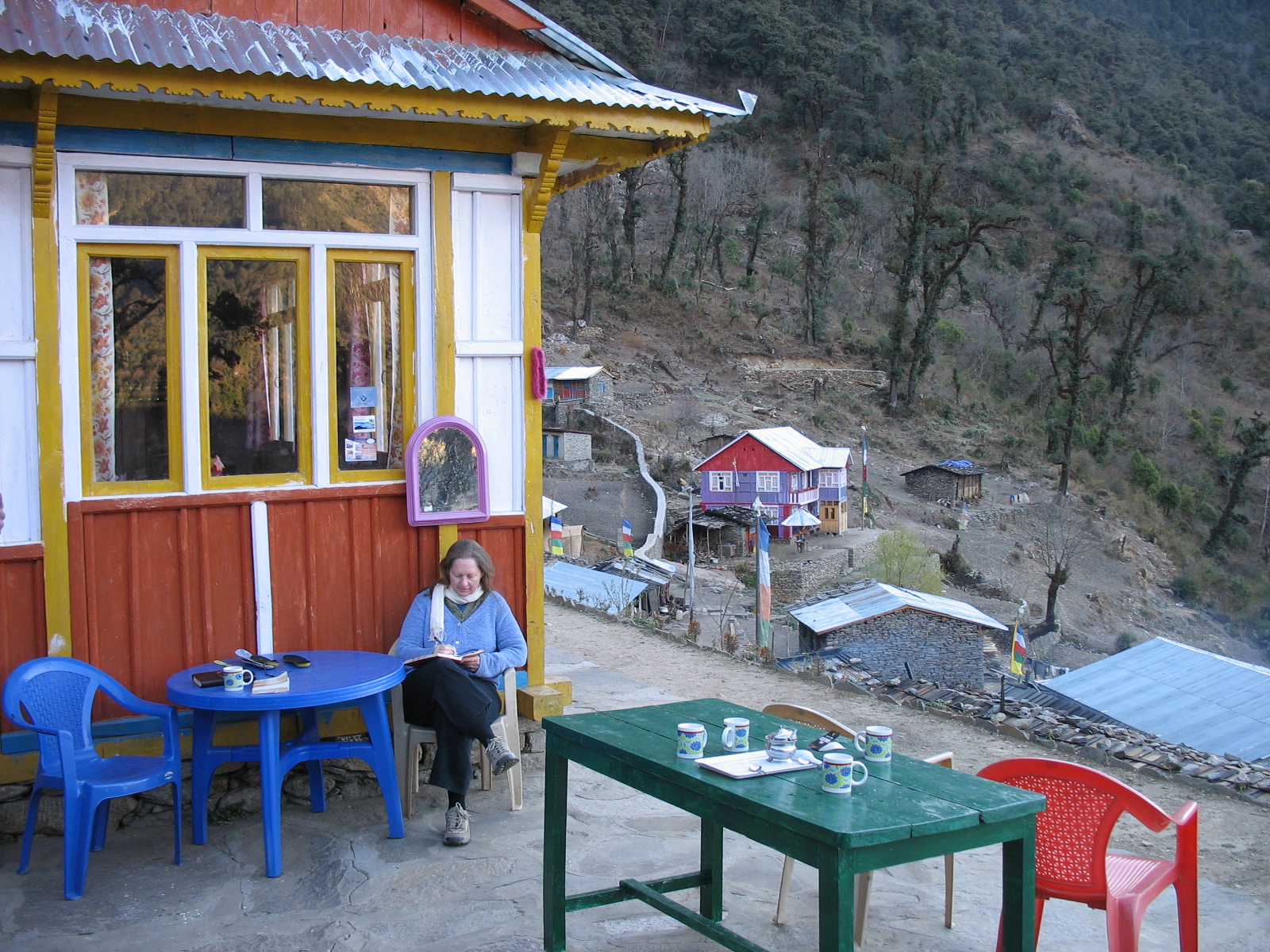
I'm sitting outside our guest house in the early morning after our bath.  We are having milk tea and waiting for breakfast.  Here you see me writing the Lyrics to 'A Froggy Went a Courtin,' for JR to teach his students.


Our gear is packed and ready for the hike back down.  Tania and JR are standing in front of the kitchen building.


This is what it looks like inside the kitchen.  Actually it was very dark inside, but my camera has illuminated the view for you.
Tatopani

Goodbye, Tatopani.  Goodbye, Spectacular View.  I hope I will come this way again someday.

Friday, June 11, 2010

Climbing to Tatopani

About 2 hours from Dunche, and 9 hours from Kathmandu, we finally reached a place where vehicles could no longer travel. Ahead of us were rocky treeless mountains and beyond the mountains the radiant snow covered peaks of Tibet.

From the road a dusty path took us to a hanging bridge that must have been very recently created. I have been across bridges that had no netting and wooden slats rotted through. Where there were holes, a flat rock bridged the gap. This bridge however was very sturdy. At this time of the year animals could be herded through the river below, but in the rainy season, the bridge would be the only access to trade with civilization.


Just beyond the bridge we encountered an old chorten. It was inscribed with prayers for the deceased. The proper way to show respect is to pass the chorten to the left circumambulating clockwise just as you would travel around a stupa.

Suddenly, the path took a sharp, steep turn to the right and we began to climb the rocky steps. It wasn't too difficult at first. I took my time placing my feet carefully so that I wouldn't slip. But soon I felt unstable in my knees and ankles. Even though I was carrying nothing but a walking stick, the climb was very difficult for me. I am at least 40 pounds overweight, which everyone in Nepal generously offered to cure with vegetables, herbs, work and yoga. I stopped often and about a half hour into the climb I decided to take my pulse. It was 170 beats per minute.


About 10 years before this journey, I broke my ankle in three places. I still have a metal plate with screws holding it all together. When I broke my ankle, it was on a most ordinary hike in the Maryland woods, nothing like these gravel covered rocky steps clinging to the side of the mountain. A simple misstep and I had to have 4 people carry me out of the woods strapped to a board. "What would happen if I broke a leg up here?" I wondered out loud. JR told me that if I broke my leg on the mountainside that they could not help me in Dunche, they would have to take me all the way back to Kathmandu. He said that they would call for a helicopter. That would be fine for me, I thought, somehow we would figure out how to pay for the rescue, but what of the thousands of people who lived up in these hills?


I know that everyone was concerned about me. They never raced ahead even though I think it would have been easier for them to climb more quickly. They were especially worried when I began to feel dizzy, and they asked if I wanted to stay with one of the families living on the side of the hill. Could I do it? Could I climb all the way to the top? Yes... yes, I was doing it. One step was not too much to bear and what is a journey but one step at a time? JR sang folk tunes behind me and I focused on the glittering rocks and the beautiful terraces, and in that way we climbed. Although it was difficult and painful, the pain would be but a moment and the beauty would be just as fleeting. I was being honored by my extended family with this most precious gift of seeing a place that only a tiny fraction of the world will ever see first hand.


It takes a native 1 and 1/2 hours to climb that mountain. It takes a fit young American 2 hours to climb to the top. It took me 4 hours, but I did it. Life is not a competition, not even with ourselves, it is a journey made up of precious moments, each one to be savored as it is presented.

The village by the river at the center of the picture is where we began our climb.
By the time we arrived, it was already dark.

Thursday, June 3, 2010

Blue Sky, Clear Water

Heading for the Tibetan Border


Dunche

Dunche

I tried very hard to take a good picture of Dunche for you. It is the largest village in this region, the one that you can find on a map. Our vehicle was shaking so violently that this was the best I could do.

It really isn't a very large village, but it is an important one. There is a military check point there where we had to show proper permits to enter the region. Not far away we saw policemen on training exercises running uphill in formation carrying their guns. There is a history of political conflict here. It is also very close to China, formerly Tibet.


Long past Dunche, there were many smaller villages. At the confluence of streams, wherever there is water and a bit of flat land, you will find people trying to eek out a living. If it does not have a house on it, it is because a home was not sustainable there. The power lines that you see are bringing electricity to these tiny villages from the hydroelectric plants. They actually have more reliable power up in the hills than they do in the capital of Kathmandu.

Water is the key to life in this terrain. As the glaciers disappear from the Himalayas, there is less water for the terraced farms. Without the vegetation the terraced fields turn to brown dust and erode. I saw hundreds of abandoned fields. There were whole sides of mountains that had turned brown and barren dotted with empty broken dwellings. In one area, I saw a brown abandoned mountain that faced a lush green productive mountain. Viewed from the valley, it was a very striking contrast. The difference between these two mountains was irrigation.

One of the best projects that I have seen in Nepal were little fish hatcheries. I saw several large concrete ponds on the mountainsides. All they need is a good spring to feed the pond and they could raise a Japanese variety of rainbow trout to eat and to sell. Many of the hatcheries had restaurants right next to the road serving the fish they raised.

Speaking of fresh fish, after 4 hours of bouncing around, it was time to stop for brunch. We were getting very near the area where we were going to begin our hike. There was no fish for us though. We had the usual: milk tea, lentils, rice, vegetable curry and eggs.


Tania, Belief and JR are above, I think TN is sitting behind his younger brother.

The housing and clothes were much different in Langtang. They had a more Tibetan flavor to them. There were Buddhist symbols carved on the doors, and prayer flags and chortens were all over the village. Neat rows of clean houses decorated in primary colors lined the streets.


Tania found a Cyber Cafe all the way up here with a good connection and sent a quick note to her employees in Brookline, MA, about what they need to do for an upcoming sale. We don't really get away from work any more, do we?

This whole area looks newly built.


A Chorten; you really need to click on these photos to see the details.


The buildings that you see across the river are a Tibetan Refugee camp.

A better image of the camp.


More beautiful children looking for something to do by the side of the road in the small village where we had brunch.

We were getting very close to the beginning of our hike up to the hot springs. That will be in the next post.

Saturday, May 29, 2010

Get Up and Get Moving

We had a big day planned! Tania, JR, TN, Belief, Atit and I were headed up to the highest hot springs in the world. We got up early, rolled our bags together and headed for Tatopani which means (hot water) in the Langtang district of Nepal. (Tato = hot, Pani = water.)

Remember me suffering down the side of the mountain? Well, I was surprisingly not nearly as crippled as I thought that I would be the next day. Clinging to Aama's walking stick. I slowly hiked back up to the road with Tania, TN, JR, Belief and Atit. The men carried my belongings. Along the way we saw several hairy little calling cards from the leopards. It was the furriest poop I've every seen.

This image is from later in the trip.

The hillside was bustling by the time we left. People were carrying heavy loads up and down the mountainside. I had promised one of my customers in the USA that I would take a picture of a mule train on this trip. The mule trains are highly decorated with bells and pompadors. I was surprised that I didn't see any in this area of Nepal. TN told me that no one in this area used mule trains because the mules took jobs from the local people who can make money portering loads on their heads.


Our driver was waiting for us with the land rover to take us north toward the Tibetan border. The road we traveled was under construction. We saw hundreds of people in small groups of 6 or 10 working on various parts of the construction. Some of the people were chipping and assembling rocks to be bailed and used for reinforcement at the side of the road. You can see a bit of the wire at the bottom of the image above. I didn't know until this trip that the chicken wire used to bail these rocks was hand woven. In a few places, I saw great "looms" made of pegs in the ground and enormous spools of wire. A man or maybe a couple of men would be wrapping the wire around the pegs to make a net. The net was then used to make a rectangular cage for rocks which could be used as building blocks to support the road.


Four the next four hours we rattled up the side of the mountain over the gravel and pot holes. Rarely did we achieve more than 15 miles per hour. Our spines were constantly pounded up and down and side to side. TN said, "It's like getting a massage."


My eyes were fixed on the goal for most of the ride.

In many places the road it was so narrow that we had to back up quite a distance to let another bus or truck pass. We would be perched so precariously at the side of the road waiting for the vehicle to pass that we would have suffered a serious fall had we chosen to open our car door. At times we could neither see around the bend nor over the rise, making the horn an essential part of our equipment.


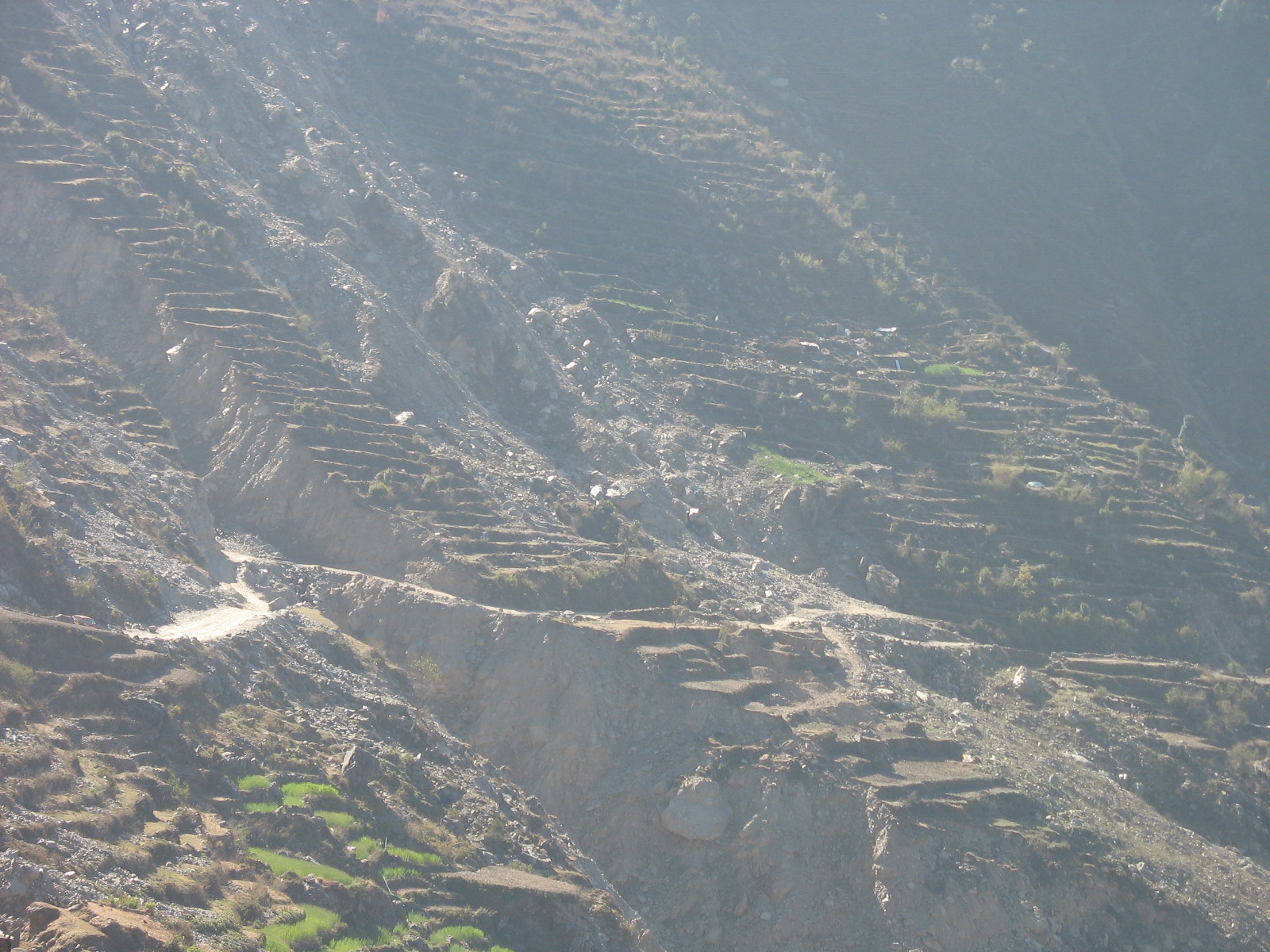
Landslides were a real potential hazard. The section of road that I have photographed here is usually closed about 4 months in the summer every year. When the rains come, it washes the rocks and mud over the road and it takes people months to dig it back out again. Even with modern technology, it is hard to imagine how human beings might ever overcome erosion on this massive scale.


Yes, this is the road that we drove on.


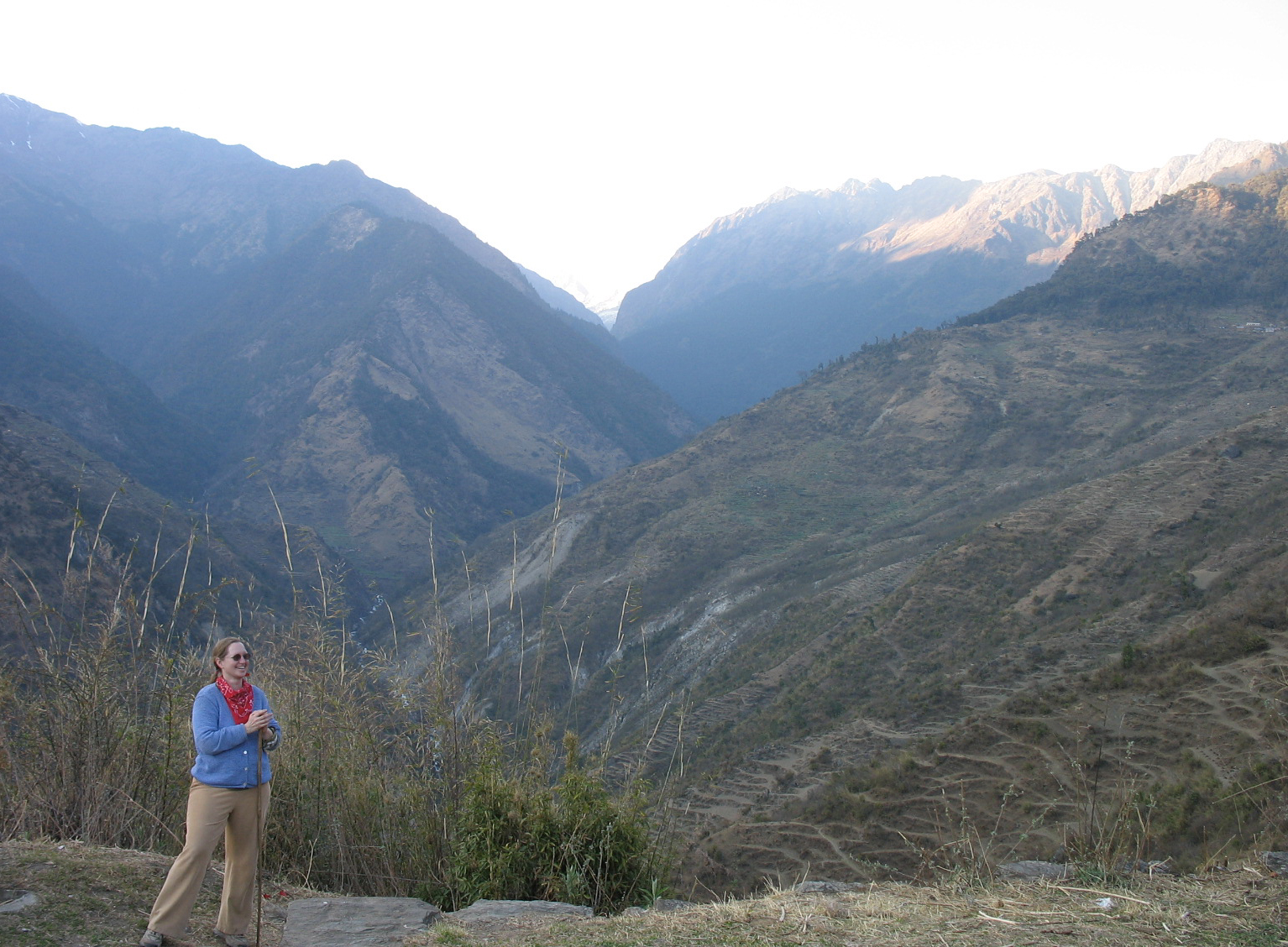
Beautiful, Dramatic, Soaring, I need better words...

The Land rover rattled so much, I'm amazed that it didn't rattle apart. Most of my pictures were very fuzzy. I hope you will click on these so that you can really grasp the vastness of the scenery.

Happy holiday everyone!