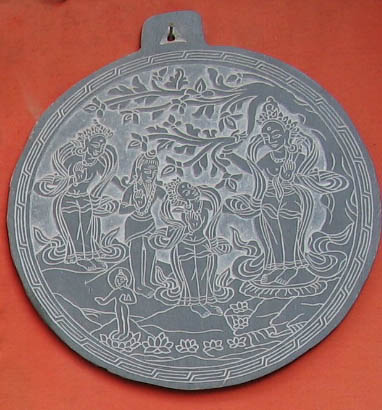
This Drawing was created by my eldest, Joshua
 It is written that when the master of Yogis, Padmasambhava, performed the powerful Vajrakilaya rites, he made it rain by subduing three kinds of elemental spirits. These spirits, or forces, are referred to as Nagas, the serpentine spirits of water; Yakshas, giant spirits of the earth; and Kumbhandas, sylph-like spirits of air.
Dakshinkali Village Inn, a place I have visited several times, is one of my favorite places in the world. The accommodations are modest, but the beauty is other worldly. Each misty morning when I rise, there is a gardener tending the roses at the perimeter of the courtyard or sometimes on his hands and knees clipping a 8x12 foot patch of grass with a pair of scissors. There isn't much lawn in Nepal. (There isn't much lawn in the world like the oceans of lawn known in the US.) Visitors will rise early and stand barefoot and do yoga on this tiny thick carpet of soft grass. It is supposed to be very good for your health. Sometimes, from the court yard at sunrise, I can see a distant outline of the Himalayas rimmed with gold. Looking to the south-east, I can also see a road cutting through the lush valley and trailing off toward the forests of southern Nepal and the dusty northern plains of India.
There is an absolutely amazing ridge not far below the inn with a narrow path along its crest. Though local people walk here easily with mule trains, I have to crawl on my hands and knees from the mountain trail to reach the ridge because I am, just a little afraid of heights. Once I am on the ridge, I can walk on the path. The path is probably 12 feet across with an additional little bit of scrub brush and rocks on either side. Beyond that, it is about a 500 foot plunge to the valley below. When I walk down the path the ground far below rushes past me in the periphery of my vision on both sides. Each step gives me the feeling of soaring through the air.
The valley itself vibrates with with layers upon layers of ancient history and religions. Since before the written history of Nepal, a goddess cult has been associated with this Parphing area, and the region has been inhabited by practicing yoginis, women who seek spiritual knowledge and mystical insight. Located in a dark hollow at the confluence of two streams is the shrine of Dakshinkali, dedicated to the feminine principle of divinity. Animal sacrifices are offered here to the Hindu goddess Kali, signifying fertility and the reproductive power of the female. Every Tuesday and Saturday, the animals are presented to the priest who will ritually decapitate them with a khukuri knife and bathe the black stone image of Kali, in blood. This is not my favorite part of the valley. It is too dark and blood thirsty for me. But for the Hindu worshipers, it is a great place to enjoy a picnic. Kali receives the spirit of the sacrifice, while the people get to have a barbecue with the meat.
I am more comfortable with the monastery on the hill above the inn. Parphing monastery, built in the 11th century, is devoted to the feminine aspect of Buddha, Vajrayogini, or the Divine Mother. Worship of the divine mother in this area goes at least as far back as the 3rd century BC. High on the mountain side above Parphing monastery is the little cave of Lang-le-sho where the famous guru Padmasambhava and his consort, the beautiful Nepalese princess Sakyadevi, lived together and attained simultaneous enlightenment in the 8th century. In an exulted state of mind, upon emerging from the cave where their meditations took place, Padmasambhava placed his hand against the rock face of the mountain, leaving impressed forever in stone a miraculous hand print. (In my mischievous mind, I see him standing outside the cave with one hand on the rock and the other holding a lit Marlboro.)
On one of my first trips to this area, the owner of the Village Inn took me up to Lang-le-sho and I placed my hand where Padmasambhava melted the rock. It really does look like someone's hand melted the rock. From there we climbed higher above the cave, reverently passing by a circle of 6 or 7 monks whose deep resonant chants were humming in concert with a very large singing bowl. At the top of the hill, we stood among trees covered in multicolored prayer flags as we admired the incredible view of mountains, villages, winding rivers, terraced fields and rice paddies spreading for miles through the valley below.
The owner of the inn is a great story teller. That night after our climb he spent a few hours talking with me. First he showed me a picture of himself with Steven Seagal, a movie star who has been recognized by a contemporary guru as a reincarnate lama or "tulku." Several people seeking mystical insight have stayed at the inn and often they hold spiritual retreats on the property. In the middle of his story telling, the electricity went out. We lit a candle and, while the rats played in the rafters above our heads, the innkeeper told me about having seen witches flying out over the valley. He then told of a festival for the goddess in which men who carry her palanquin are dragged up and down the mountainside with their feet no longer touching the ground. "If you see the eyes of the goddess staring at you from the palanquin," he said, "you will die." Someday, I would really like to see that festival.
*For those of you hoping to go to Nepal with me this October, I will undoubtedly try to take you here. If you are interested in joining us, contact me through http://aworldofgood.com/.
I used Wikipedia to check facts for this article, but most of this information comes from the Dakshinkali Village Inn. Please do not use my stories for historical facts without researching them further.