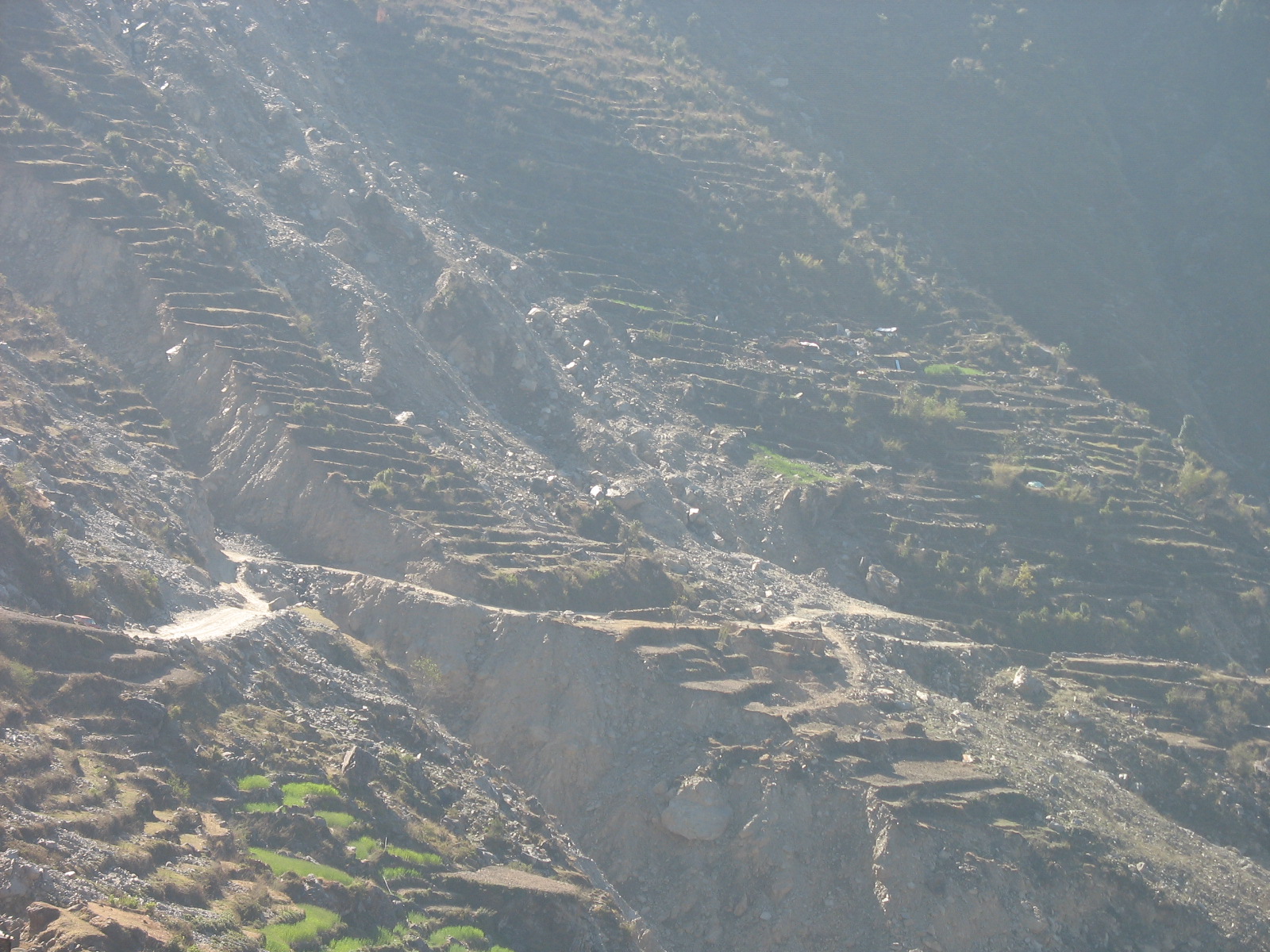
About 2 hours from Dunche, and 9 hours from Kathmandu, we finally reached a place where vehicles could no longer travel. Ahead of us were rocky treeless mountains and beyond the mountains the radiant snow covered peaks of Tibet.
From the road a dusty path took us to a hanging bridge that must have been very recently created. I have been across bridges that had no netting and wooden slats rotted through. Where there were holes, a flat rock bridged the gap. This bridge however was very sturdy. At this time of the year animals could be herded through the river below, but in the rainy season, the bridge would be the only access to trade with civilization.
Just beyond the bridge we encountered an old chorten. It was inscribed with prayers for the deceased. The proper way to show respect is to pass the chorten to the left circumambulating clockwise just as you would travel around a stupa.
Suddenly, the path took a sharp, steep turn to the right and we began to climb the rocky steps. It wasn't too difficult at first. I took my time placing my feet carefully so that I wouldn't slip. But soon I felt unstable in my knees and ankles. Even though I was carrying nothing but a walking stick, the climb was very difficult for me. I am at least 40 pounds overweight, which everyone in Nepal generously offered to cure with vegetables, herbs, work and yoga. I stopped often and about a half hour into the climb I decided to take my pulse. It was 170 beats per minute.
About 10 years before this journey, I broke my ankle in three places. I still have a metal plate with screws holding it all together. When I broke my ankle, it was on a most ordinary hike in the Maryland woods, nothing like these gravel covered rocky steps clinging to the side of the mountain. A simple misstep and I had to have 4 people carry me out of the woods strapped to a board. "What would happen if I broke a leg up here?" I wondered out loud. JR told me that if I broke my leg on the mountainside that they could not help me in Dunche, they would have to take me all the way back to Kathmandu. He said that they would call for a helicopter. That would be fine for me, I thought, somehow we would figure out how to pay for the rescue, but what of the thousands of people who lived up in these hills?
I know that everyone was concerned about me. They never raced ahead even though I think it would have been easier for them to climb more quickly. They were especially worried when I began to feel dizzy, and they asked if I wanted to stay with one of the families living on the side of the hill. Could I do it? Could I climb all the way to the top? Yes... yes, I was doing it. One step was not too much to bear and what is a journey but one step at a time? JR sang folk tunes behind me and I focused on the glittering rocks and the beautiful terraces, and in that way we climbed. Although it was difficult and painful, the pain would be but a moment and the beauty would be just as fleeting. I was being honored by my extended family with this most precious gift of seeing a place that only a tiny fraction of the world will ever see first hand.
It takes a native 1 and 1/2 hours to climb that mountain. It takes a fit young American 2 hours to climb to the top. It took me 4 hours, but I did it. Life is not a competition, not even with ourselves, it is a journey made up of precious moments, each one to be savored as it is presented.
The village by the river at the center of the picture is where we began our climb.
By the time we arrived, it was already dark.
Tears of Shiva shed into rivers. Cherry blossoms fell. The goddess of the confluence admired them for a time before she released them. The tears scoured suffering. The petals added beauty. The river flows on. I watch where streams of consciousness flow into one another and write what I see.
Friday, June 11, 2010
Thursday, June 3, 2010
Blue Sky, Clear Water
Heading for the Tibetan Border
Dunche
Dunche
I tried very hard to take a good picture of Dunche for you. It is the largest village in this region, the one that you can find on a map. Our vehicle was shaking so violently that this was the best I could do.
It really isn't a very large village, but it is an important one. There is a military check point there where we had to show proper permits to enter the region. Not far away we saw policemen on training exercises running uphill in formation carrying their guns. There is a history of political conflict here. It is also very close to China, formerly Tibet.
Long past Dunche, there were many smaller villages. At the confluence of streams, wherever there is water and a bit of flat land, you will find people trying to eek out a living. If it does not have a house on it, it is because a home was not sustainable there. The power lines that you see are bringing electricity to these tiny villages from the hydroelectric plants. They actually have more reliable power up in the hills than they do in the capital of Kathmandu.
Water is the key to life in this terrain. As the glaciers disappear from the Himalayas, there is less water for the terraced farms. Without the vegetation the terraced fields turn to brown dust and erode. I saw hundreds of abandoned fields. There were whole sides of mountains that had turned brown and barren dotted with empty broken dwellings. In one area, I saw a brown abandoned mountain that faced a lush green productive mountain. Viewed from the valley, it was a very striking contrast. The difference between these two mountains was irrigation.
One of the best projects that I have seen in Nepal were little fish hatcheries. I saw several large concrete ponds on the mountainsides. All they need is a good spring to feed the pond and they could raise a Japanese variety of rainbow trout to eat and to sell. Many of the hatcheries had restaurants right next to the road serving the fish they raised.
Speaking of fresh fish, after 4 hours of bouncing around, it was time to stop for brunch. We were getting very near the area where we were going to begin our hike. There was no fish for us though. We had the usual: milk tea, lentils, rice, vegetable curry and eggs.
Tania, Belief and JR are above, I think TN is sitting behind his younger brother.
The housing and clothes were much different in Langtang. They had a more Tibetan flavor to them. There were Buddhist symbols carved on the doors, and prayer flags and chortens were all over the village. Neat rows of clean houses decorated in primary colors lined the streets.
Tania found a Cyber Cafe all the way up here with a good connection and sent a quick note to her employees in Brookline, MA, about what they need to do for an upcoming sale. We don't really get away from work any more, do we?
This whole area looks newly built.
A Chorten; you really need to click on these photos to see the details.
The buildings that you see across the river are a Tibetan Refugee camp.
A better image of the camp.
More beautiful children looking for something to do by the side of the road in the small village where we had brunch.
We were getting very close to the beginning of our hike up to the hot springs. That will be in the next post.
Dunche
Dunche
I tried very hard to take a good picture of Dunche for you. It is the largest village in this region, the one that you can find on a map. Our vehicle was shaking so violently that this was the best I could do.
It really isn't a very large village, but it is an important one. There is a military check point there where we had to show proper permits to enter the region. Not far away we saw policemen on training exercises running uphill in formation carrying their guns. There is a history of political conflict here. It is also very close to China, formerly Tibet.
Long past Dunche, there were many smaller villages. At the confluence of streams, wherever there is water and a bit of flat land, you will find people trying to eek out a living. If it does not have a house on it, it is because a home was not sustainable there. The power lines that you see are bringing electricity to these tiny villages from the hydroelectric plants. They actually have more reliable power up in the hills than they do in the capital of Kathmandu.
Water is the key to life in this terrain. As the glaciers disappear from the Himalayas, there is less water for the terraced farms. Without the vegetation the terraced fields turn to brown dust and erode. I saw hundreds of abandoned fields. There were whole sides of mountains that had turned brown and barren dotted with empty broken dwellings. In one area, I saw a brown abandoned mountain that faced a lush green productive mountain. Viewed from the valley, it was a very striking contrast. The difference between these two mountains was irrigation.
One of the best projects that I have seen in Nepal were little fish hatcheries. I saw several large concrete ponds on the mountainsides. All they need is a good spring to feed the pond and they could raise a Japanese variety of rainbow trout to eat and to sell. Many of the hatcheries had restaurants right next to the road serving the fish they raised.
Speaking of fresh fish, after 4 hours of bouncing around, it was time to stop for brunch. We were getting very near the area where we were going to begin our hike. There was no fish for us though. We had the usual: milk tea, lentils, rice, vegetable curry and eggs.
Tania, Belief and JR are above, I think TN is sitting behind his younger brother.
The housing and clothes were much different in Langtang. They had a more Tibetan flavor to them. There were Buddhist symbols carved on the doors, and prayer flags and chortens were all over the village. Neat rows of clean houses decorated in primary colors lined the streets.
Tania found a Cyber Cafe all the way up here with a good connection and sent a quick note to her employees in Brookline, MA, about what they need to do for an upcoming sale. We don't really get away from work any more, do we?
This whole area looks newly built.
A Chorten; you really need to click on these photos to see the details.
The buildings that you see across the river are a Tibetan Refugee camp.
A better image of the camp.
More beautiful children looking for something to do by the side of the road in the small village where we had brunch.
We were getting very close to the beginning of our hike up to the hot springs. That will be in the next post.
Labels:
Chorten,
Dunche,
Himalyas,
Langtang,
Prayer Flags,
Rainbow Trout,
Tibetan
Saturday, May 29, 2010
Get Up and Get Moving
We had a big day planned! Tania, JR, TN, Belief, Atit and I were headed up to the highest hot springs in the world. We got up early, rolled our bags together and headed for Tatopani which means (hot water) in the Langtang district of Nepal. (Tato = hot, Pani = water.)
Remember me suffering down the side of the mountain? Well, I was surprisingly not nearly as crippled as I thought that I would be the next day. Clinging to Aama's walking stick. I slowly hiked back up to the road with Tania, TN, JR, Belief and Atit. The men carried my belongings. Along the way we saw several hairy little calling cards from the leopards. It was the furriest poop I've every seen.
This image is from later in the trip.
The hillside was bustling by the time we left. People were carrying heavy loads up and down the mountainside. I had promised one of my customers in the USA that I would take a picture of a mule train on this trip. The mule trains are highly decorated with bells and pompadors. I was surprised that I didn't see any in this area of Nepal. TN told me that no one in this area used mule trains because the mules took jobs from the local people who can make money portering loads on their heads.
Our driver was waiting for us with the land rover to take us north toward the Tibetan border. The road we traveled was under construction. We saw hundreds of people in small groups of 6 or 10 working on various parts of the construction. Some of the people were chipping and assembling rocks to be bailed and used for reinforcement at the side of the road. You can see a bit of the wire at the bottom of the image above. I didn't know until this trip that the chicken wire used to bail these rocks was hand woven. In a few places, I saw great "looms" made of pegs in the ground and enormous spools of wire. A man or maybe a couple of men would be wrapping the wire around the pegs to make a net. The net was then used to make a rectangular cage for rocks which could be used as building blocks to support the road.
Four the next four hours we rattled up the side of the mountain over the gravel and pot holes. Rarely did we achieve more than 15 miles per hour. Our spines were constantly pounded up and down and side to side. TN said, "It's like getting a massage."
My eyes were fixed on the goal for most of the ride.
In many places the road it was so narrow that we had to back up quite a distance to let another bus or truck pass. We would be perched so precariously at the side of the road waiting for the vehicle to pass that we would have suffered a serious fall had we chosen to open our car door. At times we could neither see around the bend nor over the rise, making the horn an essential part of our equipment.
Landslides were a real potential hazard. The section of road that I have photographed here is usually closed about 4 months in the summer every year. When the rains come, it washes the rocks and mud over the road and it takes people months to dig it back out again. Even with modern technology, it is hard to imagine how human beings might ever overcome erosion on this massive scale.
Yes, this is the road that we drove on.
Beautiful, Dramatic, Soaring, I need better words...
The Land rover rattled so much, I'm amazed that it didn't rattle apart. Most of my pictures were very fuzzy. I hope you will click on these so that you can really grasp the vastness of the scenery.
Happy holiday everyone!
Labels:
Langtang,
Nepal,
Road Building,
Road Travel
Tuesday, May 18, 2010
Kids and Leopards
Aama: 'Mother' This is the most esteemed matriarch of the Neupane family. She is a mother of 15 and has already out lived 8 of her children. Sitting here with her eldest son, I thought she looked most dignified. Although we could not speak directly to one another, I was honored by her presence and welcomed by her impeccably raised and generous family. Many, many thanks to Aama and to her family.
If you look to the left of Aama, you will see a rock. This is a pestle. The mortar is the stone beneath it. It is where Aama grinds her spices. We accidentally sat on the mortar, but we were forgiven.
After our meeting at the school, we were taken back to our host's home. Normally, I would offer to help in the kitchen, but in this case, I was exhausted and I allowed myself to be cared for. Uncle JR, an English teacher, and his wife worked on the dinner together. They picked spinach from their garden. At the edges of the garden were nettles which can be used for making cloth. We also saw marijuana weeds which grow all over Nepal.
We chatted and sipped milk tea while several people from the village stopped by. Aunts, uncles and cousins dropped in to say hello.
They had an out house with running water, it was cold, but you could still take a shower if you wanted. We met a young woman named Mary who was a doctor from Texas volunteering at the local hospital for a couple of months. She had come up the hill to the Neupane's home for a shower. Dr. Mary told us that the prevailing illnesses at the hospital were a mystery rash and parasitic dysentery. In Nepal, diarrhea is the leading cause of death for children under 5.
At the far end of the house was a stable for cows and goats.
The cow had just had a calf, so we had fresh milk for our tea and I was able to drink a cup of raw milk. I thought the cooked milk tasted a little sweeter.
Uncle JR's twelve year old son was home playing with the goat. My other adopted Nephew, Atit, came up from another school a few miles away. He has barely graduated from high school himself, but he is already teaching.
Our first course was boiled salted potatoes. We peeled them with our fingers and ate about 4 potatoes each.
JR's wife did a tremendous job of feeding so many guests. She spent a long time carefully picking through and cleaning the rice. We sampled a rice wine made by a neighbor, and we had stewed spinach. She made spicy potatoes with home made butter out of the left over potatoes from earlier. There were even a few cubes of spiced goat meat for everyone.
After dinner JR played the drum for us and sang. Belief and his cousin danced and we were well entertained until we could barely hold our heads up any longer.
Before we turned in, JR carried the kids (baby goats) and the calf inside a storage room, put them under baskets and barred the door. This was to keep the leopards from eating them at night. Apparently the leopards usually leave the larger animals alone. I made certain that the bar was down on our door before we turned out our lights and climbed into our sleeping bags, just in case.
Labels:
Dinner in Nepal,
homestay,
homestay Nepal,
kids,
Leopards
Tuesday, May 11, 2010
Getting Down to Business
When I was a teacher in Japan, I had 11 regular classes of 55 students and 4 special classes of 25 students. I had to give speeches on occasion to as many as 2000 students and faculty. So, although I was surprised by the lavish attention and the impromptu speech making, I was able to whip up a little something. I found that the more I spoke, the more I promised. By the time I had finished talking, I was not just donating a few books but a whole library.
| Tania and Jeri with the teachers and elders of the community. |
| The two older gentlemen were among the first in the community to organize and create the original school. |
When I asked the children what they wanted for their school, one boy asked for sports equipment. I was imagining a soccer ball regularly flying off the side of the mountain hundreds of feet to the river below. Another young man asked for a laboratory. They have science workbooks with standard lessons that they are supposed to get through to pass their levels, but they can only read about experiments because they don't have any equipment. I promised science books but I wasn't sure that I could provide a laboratory.
The teachers showed me three old donated computers that were no longer working. If they had modern lap tops, they would be able to get a satellite connection to the Internet, although it would be very costly. The children had helped to create a promotional video for the Italian biologists to generate donations in order to get their school built, but they have never been able to see the video.
This entire community has a passion for education! They have, without the help of government, figured out who to ask for help and how to get things accomplished. Their latest idea is that they will provide a house for a volunteer to come and teach English to their students. They can't provide food, or a salary, but they will gladly give the space and generously invite a foreigner to live among them in their community. If I were young and single again, I would do it in a moment. The offer is wide open, even if you have only two months of your time to share and no formal college education. Literacy is often the qualification for teaching school in Nepal. Let me know if you are interested, contact: butternutsquash2@gmail.com
Here is the situation that we encountered. These students have only government approved workbooks to learn from. The books that I carried to them were the first that they had had in the school. There was no library to contribute to. For most of us in the developed world, that is simply unimaginable. What is a school without books? But for people whose families might make only $1 a day, there are more important things to buy with that $1.
By the end of our discussion, I had a lot to figure out. For political reasons, it is not possible to make a direct financial contribution to anyone at the school. I had to find the proper channels to make good on my promises within the following week of our journey.
I want to give a big thank you to Leenie of Sidetrips for sending books. As well as my dear friend Sarah who also sent pencils. I also received useful photos of children from Australia and the US to share from Leenie, Irene and Sarah. They were fascinated by your books!
The pencils were particularly wonderful, because I was having trouble getting the children to come close to me until I pulled out the pencils, I did not see any pencil sharpeners, but I was assured that the students were accustomed to sharpening pencils with a sickle.
If you want to make a donation of books or money, contact me and I will put you in touch with the proper channels.
Friday, May 7, 2010
Visiting a mountain village school in Nepal
I had no real plan, just a vague idea that I was going to take some books to Nepal and donate them to the school library of a small mountain school in the Rasuwa District. For several years I have been assisting two boys with their education. I wrote about these boys earlier in Dream a World of Good. Their village did not have an adequate school when the boys were young so their father moved the family to Kathmandu so that they could get an education.
Meanwhile, back in the village, several of the village leaders had been actively working to improve the quality of education in their district. They befriended a group of biologists from Italy and behold, a new school was built. This was a spectacular achievement and one that the village is enormously proud of and I'm sure the Italians are too. When I heard about the school being built, I wanted to see it and make a small personal contribution. Why? Just because I wanted to see where my adopted family had come from.
After the long ride up in the mountains from Kathmandu, we hiked about 45 minutes down a very steep and rocky path on the side of a mountain. Because I had not done any serious hiking for at least 10 years, and I am about 40 pounds overweight, by the time that we reached our host's home, I thought that I had wrecked my ankles and my knees. I was concerned that I might not be able to hike back up the mountain the following day. My adopted nephew and his father were carrying my packs and books for me, and still the local women carrying enormous loads of firewood on their heads passed me with ease.
Tania who is 10 years younger than myself and keeps herself in good physical shape with yoga did not appear to be suffering at all. I think she was overjoyed to be out of the city, on a brilliant day in the Himalayan hills. Everywhere up there the view was plunging and dramatic. I say plunging rather than soaring because I spent much of my time looking down at how far I would tumble before a tree or some rocks would break my fall. The path clung tightly to the side of the mountain and was very narrow in places. A constant flow of life, people, animals, insects all buzzing in harmony moved along the path. This was the kind of trekking Tania had been hoping for since I first mentioned that I was going to Nepal.
When we arrived at our host's home, they gave Tania and me some milk tea and let us rest for a while before they sent us another 10 minutes hiking down to the school. This time they helped me out by loaning me their grandmother's walking stick.
When we finally arrived, the upper school yard was empty, but when we turned the corner around the side of the building, hundreds of students were lined up and waiting for us. Tania and I were both astounded. We had no idea that this would be such a formal occasion.
Let that be a warning to all of you who are planning to travel with me at some point in the future. You never know what kind of a predicament I might lead you into.
The students had climbed all over the hillside collecting flowers and sewed them into necklaces (Mala) for us. Thank God Tania was there because I ran out of space around my neck for all of the necklaces that we received. When we had been properly lavished with adornments. Someone said to me, "Wouldn't you like to say something?" They were waiting for my unprepared speech.
Labels:
Education,
Mala,
Mountain School,
Nepal,
trekking
Tuesday, May 4, 2010
The Little Children are Suffering!
It is often difficult for people in the developed world to understand what happened to developing nations that left them so far behind in infrastructure and very basic things like clean water, sewage systems, electricity, hospitals and schools. Was it a lack of natural resources? Domination by a greedy colonial era superpower? Or some other catastrophe that devastated their economy and kept them from developing?
In Nepal, it seems to have been in large part due to selfish and very poor decision making by the ruling Ranas from the 1850's to the 1950's. During this period, education was only available, at a price, to the privileged elite. According to several articles available online, only between 2% and 5% of the population had at least some education in 1950, and one article reported that only 86 girls in the entire country had an education in 1950. The Ranas felt that their power would be threatened by an educated public, and so they forbade education, including contact with the outside world, and radio.
After the King reestablished his control over the Kingdom in 1951 education was allowed, although it was neither compulsory nor provided by the government. Still, some progress was made. According to the 2001 census 48.2% of the population (female: 34.6%, male: 62.2%) were literate.
During the 18 years that I have been traveling to Nepal, the government has been in a terrible upheaval and even now, in May of 2010, it has been reported that more than 100,000 people have come to demonstrate in the capital of Kathmandu in order to shut down the government with strikes until the current government steps down. These demonstrations are being promoted by a group called "The Maoists."
Here is a recent letter I read from one teacher in Nepal:
Millions of thanks to you all from the mountains of Nepal. We are praying that you are well. The situation is very bad here, Maoists are demonstrating all over the country and everything is closed. Last week they have collected a lot of money from all the Nepalese people by threatening them. We teachers are suffering more because we had to pay them 4000 Nepalese rupees (about $60) otherwise they can do anything to us. I am in my village feeding the cows and goats right now. Maybe next week our school may open. Life here is going difficult again. Millions of 'thank yous' for remembering us.
$60 would be an entire month's pay for many Nepalese teachers. These teachers often have second and third jobs to help support their families, and their spouses and children are also working in local agriculture so that their family can survive. Teachers have been abducted by Maoists, tortured, and held for ransom, because Maoists make the assumption that the teachers have more money than average citizens and therefore should be paying more. A teacher's whole family is threatened when the Maoists come to collect.
Children who have grown up in Nepal during the past 20 years have had to struggle for their education. Even if they wanted to go to school and their parents had the money to pay for it, the schools have often been closed down because of the endless general strikes. With greedy men threatening the teachers and their families, as well as some of the children's families, how will these children receive the education needed to build the necessary infrastructure? It is time for the differing political factions to work together peacefully for the prosperity of their children and their country.
The legacy all parents should give to their children is an insurance policy in happiness; but the premiums must be paid today, during their upbringing. -Param Pujya Ma
Suffer little children. Do not hinder them, either by word, or by a bad example.- Jesus (Matthew 19:14)
(This is background information to help you understand what happened when Tania and I visited a mountain school with a bag of books.)
Subscribe to:
Posts (Atom)