Showing posts with label Chitwan Jungle. Show all posts

Friday, October 1, 2010

Elephant Breeding Center, Nepal

Incredibly cute!

They have the longest gestation period of any land animal, 22 months.

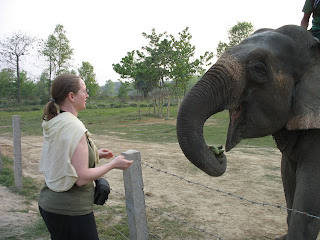
 Their caretakers make little nutritious food packets for the elephants which are useful treats during training.

Treated well, they can live into their 70's.

At about 5 years of age, they are separated from their mothers and their training begins.

Some of the young were not chained because they rarely wander far from their mothers.

It is difficult to watch the training process because you can see that the elephants are struck squarely on their heads with a fat stick if they misbehave.


The elephants are strong enough to drag a three ton tree, so it is important that the trainers have control over the elephants at all times.  Sometimes the elephants will unexpectedly lose their minds and become completely unmanageable.  After the elephant breeding center, we walked 2 miles into town to see if there was a cybercafe so that we could let people know that we might have some difficulties returning during the strike.  Halfway to town we saw roughly 20 people standing in the street keeping their eyes on a large elephant from a distance.  We continued to walk confidently toward the crowd and the elephant.  Fortunately, one man stopped us.  "The elephant is mad.  He has already killed two men.  We are waiting for the mahout to come and get him."  We thanked the man and quickly retreated.

Thursday, September 16, 2010

The Great Elephant Flip-Flop Rescue!

In January, when I normally go to Nepal, it is relatively cold and there are few tourists in Nepal.  This means that down in the jungle my guests and I are treated to private elephant rides, boat rides, and jungle walks.  In March it was a vastly different experience.  Tourists were all around us and a herd of elephants followed us into the jungle.

Loading up with tourists and preparing to depart.


I did spend some time worrying about how tightly the crate was cinched.

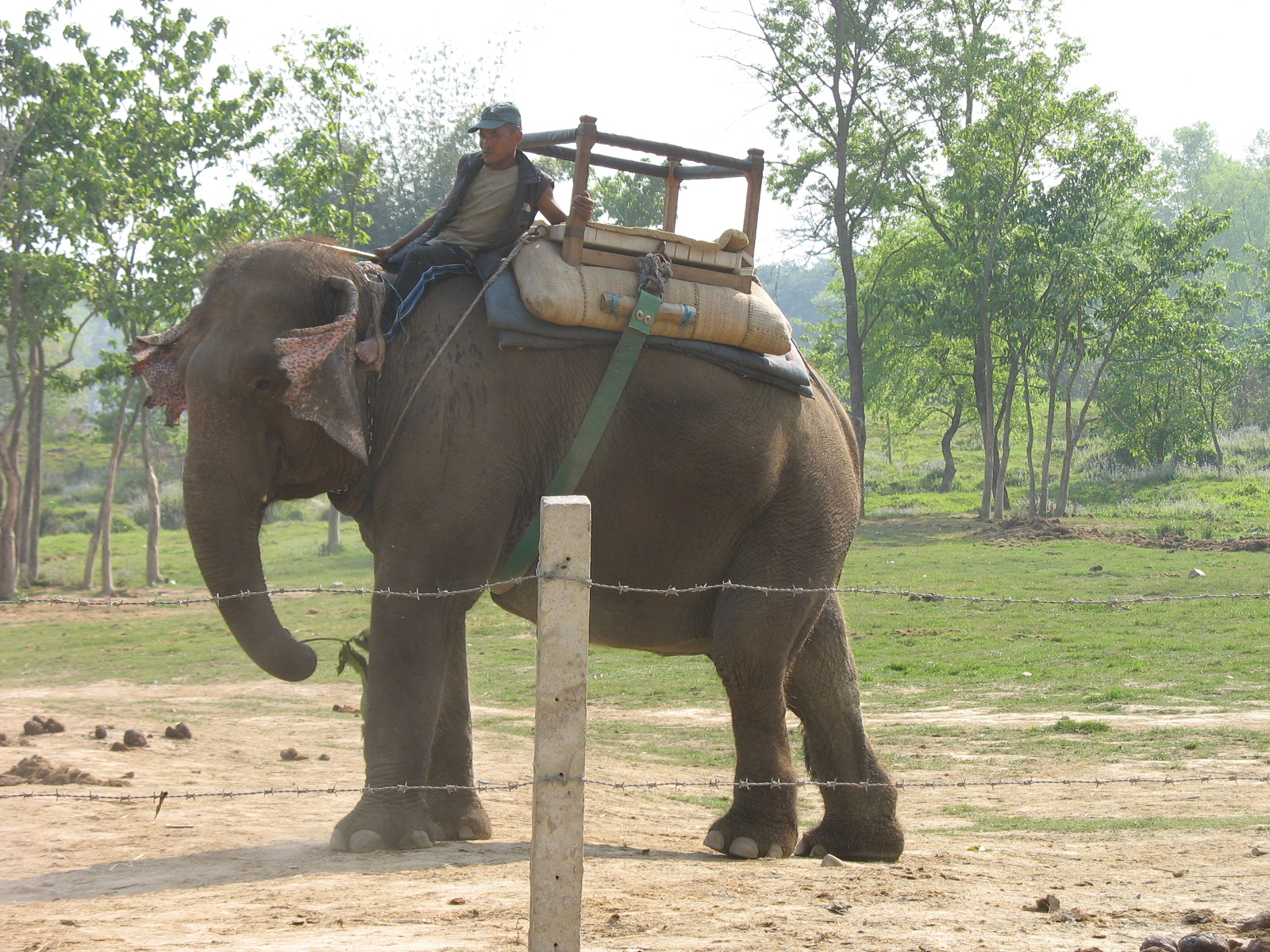
The mahout steers with his feet.

Some of the elephants were very nervous about crossing the river.  They were up to their shoulders in water, with five people on their backs.
We lurched forward and backward when the elephant slipped on the mud as it climbed out of the river and up the opposite bank into the jungle.

We looked all over for the rhino.

Do you think the rhino might have heard us and moved out of our way?


A man sharing the elephant with us lost his flip-flop shoe. 

The mahout behind us was able to direct his elephant to find the man's flip-flop in the muddy stream and return it to him.  You can see it in his hand.  Everyone was astounded.  The flip-flop was covered in mud and sloshing around in muddy water.

We did see a lot of deer.

It is amazing that on an elephant you can come right up on a deer even though you could never do that walking.


If you have a little extra time and money, you can arrange to camp over night in this building in the jungle.

Thank you for the excellent ride.  Here are some bananas.  Maybe we will catch up with the rhinos next time.

Thursday, September 9, 2010

Early Morning Boat Ride, Chitwan

Early in the morning, everything was still and dreamy.  Just imagine that you are with us.  We are taking a river ride to the jungle.
Smiley the manager has come too.  We had one man to pole the boat and another with a strong short stick to protect us from wild animals.

The sun was slow to burn off the morning mist.

I wish I knew the names of all of the birds that we saw.

I know these birds,  they are wild peacocks.

Serene

These are bird nests in the sand.

Wave and smile boys.

At last, the jungle where we will look for wild beasts.  Click to see the bird in the tree.

Good Morning Mr. Crocodile,  we will get out a little further down stream so we don't disturb you. Click to see how close we were.  When we left the jungle, we came down the path to exactly this spot where the crocodile had been resting just hours before.  This is where our boat was waiting for us.

Monday, September 6, 2010

An Oxcart Ride, Southern Nepal, part 2


Houses in the Terrai


Water Buffalo

Hay Stack

Planting Rice

Bananas

House in the Terai

Villagers in the Terai

Footprint decorations on a house

Spring flowering tree in the Terai
The Terai is the forested flat low land in the southern part of Nepal.  It has always had people living in it, but relatively few until after 1950 when it was liberally sprayed with DDT.  Before that it was malaria infested, so the animals had the place more or less to themselves.  The population exploded from 8 million people in 1950 to 20 million people in 2000.  Today there is a lot of discussion about creating more useable farmland out of the Terai which means encroaching even more on the forest.  Although there is a great effort to maintain the Chitwan Jungle for its extraordinary wild life, the people who live there have to put up with wild rhinos, elephants, crocodiles and tigers and now ox carts full of tourists.  It's quite a balancing act to accomodate them all.

Friday, September 3, 2010

An Ox Cart Ride in southern Nepal, Part 1


Tourists Preparing for Departure
On these trips it is very hard to tell who is on display.  Are we looking at the villagers, or are we on parade for them.  I have been told by guides that they walk the ox along a different path every time so that we don't disturb anyone in the village too much.
The stone structure on the right was built as a platform from which you could mount an elephant.  The last time I was at the lodge it wasn't built yet, so we climbed the elephant's hind end using his crossed legs and his tail.

That ox is wondering how many tourists are going to be crammed onto his cart.

Wow, the heavy wooden yoke on his neck looks uncomfortable.  Our Ox cart driver also races elephants, check out his T-shirt

I guess everyone is a little crammed together in Nepal.

No hands!  The water buffalo behind her is looking a very thin.

Looks like fun!
The Terrai in the south is flat land unlike most of the rest of Nepal.  There is none of the amazing architecture that you would see up in the Kathmandu, valley.  The people here look thinner, their animals look thin and their homes are very simple mud and stick structures.  I'll show you more soon.

Thursday, May 28, 2009

Honesty and Poverty

I had to create this image from some toys in my dining room because I have lost all of the pictures that I have ever taken in the jungle. (That's another story.)

My uncle stroked the elephant and praised it like he would his dogs. He had even come prepared with a few fruity snacks that the little elephant took politely with the tip of its trunk and deposited into its mouth. Elephants look so sad and wise at the same time. I thought I saw a curious appreciation for my uncle's kindness in its long lashed eye.
They had not yet finished building the platform stairs so that we could easily climb into the crate saddled on the elephant's back, so the Mahout commanded the elephant to lie on its belly and cross its hind legs. My uncle, already in his late 60's, climbed up, stepping first on the back of one of the elephant's legs, then the other, and then onto the tail which the Mahout gripped tightly next to the elephants back side to form another step. He grabbed the edge of the crate with one hand and hoisted his body up onto the elephant's back and climbed into the crate. My uncle's legs dangled down over the right front shoulder of the elephant. I climbed up next, and seated myself in the opposite corner of the crate looking to the rear of the elephant. The Mahout nimbly scampered up the front leg of the elephant and swung his legs around the elephant's neck placing his bare feet gently behind its ears so that he could steer the elephant.
The elephant walked slowly down the road and over a bridge to a small village that was surrounded by a fence of prickly cactus. The cactus had been planted to keep the rhinos out, but I was told that a few people had to stay up all night to watch for rogue animals all the same. The village was full of open air shacks with few walls. You could see every detail of the inhabitants' lives. They seemed just as curious about us as we were about them and would smile and press their hands together in greeting as we passed. Some of the children ran along side of the elephant and waved to us. Village cows, chickens, goats and pigs scattered in front of our parade. But the children stayed back as the elephant stepped into the low lying mists of the jungle.

I had ridden on elephants before that were much larger than this one. Usually, the ride was smooth, graceful, and remarkably quiet. I was surprised at the brutal lumpiness of this ride. We lurched forward and back relentlessly with our ribs banging into the wooden bars on the crate. After a while, I tucked my coat down around my ribs to provide some extra padding. Painful as it was, it was still an exhilarating ride through the jungle. There are animals that you can see from an elephant's back that you usually do not see while walking through the jungle. The deer, wild boar, peacocks, monkeys and rhinos all stay around a little longer when an elephant is coming down the path compared to a group of noisy people tramping through. Sitting quietly on the elephant's back, we were able to stand only a few feet from a wild elephant, her baby and a few rhinos.

For about 2 hours we rode up and down jungle paths and created a few of our own paths in grass that was as tall as the elephant's eyes as we looked for a tiger. We saw tiger tracks, but never found a tiger. Few people do. Finally, we returned to our camp. I started searching my coat pockets for my wallet so that I could give the Mahout a tip. As I patted about my pockets, a deep sick feeling welled up in my belly and a cold sweat started to break out on my brow. The wallet was gone. I had done something I never do, I put the wallet with my driver's license, credit cards and all of my cash into my coat pocket. Normally, I have hidden zippered pockets and extra wallets so that I don't lose everything at once. I did still have back up cards and a passport tucked away in a safe place, but there are many places in Nepal where credit cards are useless, so one must carry small bills in Nepalese Rupees.

Immediately, I told the camp manager what had happened and he explained it to the Mahout. The Mahout, 3 men and the elephant went right back into the jungle without even stopping for lunch. I didn't have a lot of hope that they would find the wallet though. Not only had we gone on a long complicated journey, the jungle is not as empty of people as you might imagine. Plenty of people regularly walk up and down the jungle paths.

My uncle and I had a worried lunch after which I retired to my cabin alone to consider from whom I would borrow money so that I could comfortably continue on my journey and how I was going to cancel all of my cards from the remote area where we were staying. I fell asleep. About two hours later, someone called from the jungle. They had found a river of coins gleaming in the sunlight and followed it to my wallet. When they returned, they were smiling triumphantly. My uncle gave the search party about $20 from my wallet, to split 4 ways. I think that I would have given them much more than that, but he said that they all seemed very pleased.

There was the equivalent of $200 US in Nepalese Rupees in my wallet. To give you some perspective about what these men did for me, you need to know that, according to the Wilson Center and the WWF, the average per capita annual income for the country of Nepal is only about $235. In the Terrai region, where I was jungle trekking, the annual per capita income is more like $50. Yes, that is $50 per person per year! That would have been a year's income for each one of them. The next time you go to the jungle in Nepal, let me know and I will happily tell you a very honest group to travel with.

If you look at the pictures of Nepal on my side bar, you can find pictures of tourists riding elephants in the Terrai.